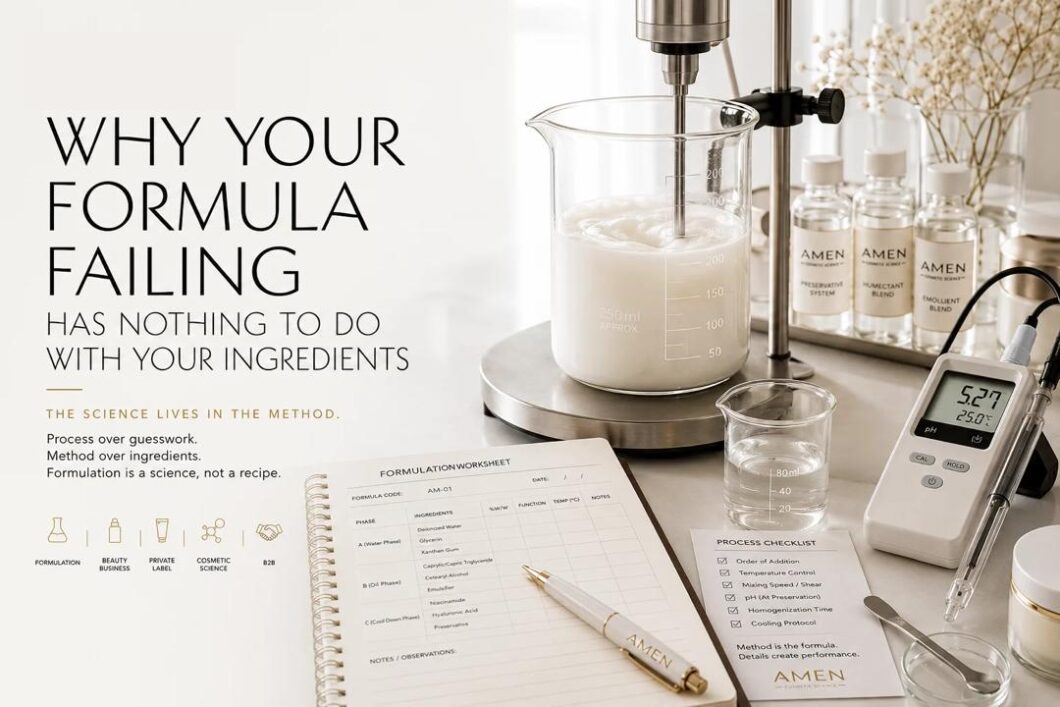
Seven years in, this is the conversation most brand owners need and nobody is having with them.
I have seen it more times than I can count. A brand owner comes to me with a formula that is not performing. The texture is off. The skin feel is wrong. The product separated on the shelf. And the first thing they do is blame the ingredient, change the active, swap the oil, reduce the preservative.
Nine times out of ten, the ingredient is not the problem.
Formulation failure is almost always a process failure. The order of addition. The temperature at which you are introducing your actives. The shear rate during emulsification. The pH at the point of preservation rather than the pH of the finished product. These are the variables that determine whether your formula performs, not just what is in it.
An experienced formulator does not just read an ingredient’s function. They understand its behaviour. How it interacts with the other components in the system. What it needs to perform and what will suppress it. A hyaluronic acid that is not hydrating is not a bad ingredient, it is an ingredient that was introduced incorrectly, or sitting in a pH environment where it cannot do its job.
This is why copying a formula never works. You can have the exact same INCI list as a product you admire and produce something completely different because formulation is not a recipe. It is a science, and the science lives in the method.
Seven years of this work has taught me that the most expensive thing a brand owner can do is guess. The second most expensive thing is to keep changing the ingredient when the process is what needs to change.
Before you reformulate, look at your method first.
With expertise and honesty,
Adesoye